



By Alix Castillo Serrano
Psychology student
Member of the GOYN-Barranquilla Advisory Group
The pressure of being a woman between culture, identity and mental health
How much of what we do, believe, and are is truly a personal choice? At what point did we lose the power to decide and live freely?
In psychology there is a term called social conformity, a process by which people adapt their thoughts, behaviors and decisions to fit with the norms, expectations or behaviors of a group.
What strikes me most about this concept is that we have made it commonplace and, even unconsciously, much of what we do and who we are passes through the filter of: "What will others say about me?".
Our culture has set standards for everything, and in the case of women, these standards are often extremely difficult to meet.
The things we value, yearn for, and want to emulate, Are they truly a personal decision, or are we simply caught in a bandwagon effect?
When something is constantly repeated, it stops seeming like a preference and starts feeling like a rule. Our society has established an idea of the perfect woman: a physically flawless woman, docile and submissive, and whose aspirations aren't too ambitious. Thousands of films, TV series, advertisements, songs, and even social norms act as constant reinforcers of this impossible ideal.
It's often said that beauty is subjective, but in reality, many women seem to be constantly chasing an impossible ideal and have an endless need for approval and validation. Culturally, beauty is often valued more highly. On social media, for example, the "pretty privilege" phenomenon recently went viral: stories and anecdotes from girls and boys showing how, solely because of their physical appearance, they receive kinder treatment and greater benefits than others.
There is a popular phrase attributed to Franz Kafka that says: “If you kill a cockroach, you’re a hero. If you kill a butterfly, you’re a villain. Morality has aesthetic standards.” And perhaps that is one of the simplest ways to explain why, even today, we continue to associate the value of people with how close they are to certain ideals of beauty.
It is unfair to think that women who do not fit within those standards have to constantly compensate with their personality, intelligence, or abilities.
More troubling than the existence of these ideals is how deeply ingrained they are. From a young age, we learn which types of women receive admiration, attention, and acceptance, and which do not. At school, we see how the group is divided between "the pretty girls" and "the smart girls." In adolescence, many of those girls who felt they didn't fit in tried to compensate by being kinder or funnier. In adulthood, appearance continues to open doors, and those who don't manage to "get in" that way are often forced to work twice as hard.
A clear example of this appears in *Yo soy Betty, la fea* (Ugly Betty): an intelligent and capable woman who, because she didn't fit the beauty standards, had to endure humiliation and constant underestimation. The saddest part is that Betty had to transform her appearance to finally be taken seriously. How many films, books, and songs also tell the story of the "not-so-pretty" girl patiently waiting to be seen? We grew up thinking that, at some point, we should change; that our worth would come when we were finally accepted. We would go from being an ugly duckling to a swan.
Long before social media or today's visual culture, literature already addressed women trying to survive imposed expectations that, while including physical appearance, went far beyond that. In The Handmaid's Tale, Margaret Atwood shows how women lose their rights, their freedom, and their autonomy; their bodies no longer belong to them. They are reduced to what society expects of them. They lose their value as human beings and end up as objects defined by their usefulness.
But What would happen if women refused to be dominated by those social structures? In Herland, Charlotte Perkins Gilman imagines a society composed solely of women and breaks with many of the stereotypes and prejudices traditionally associated with femininity. Through this novel, she demonstrates that many of the ideas we consider “natural” about women may simply be cultural constructs.
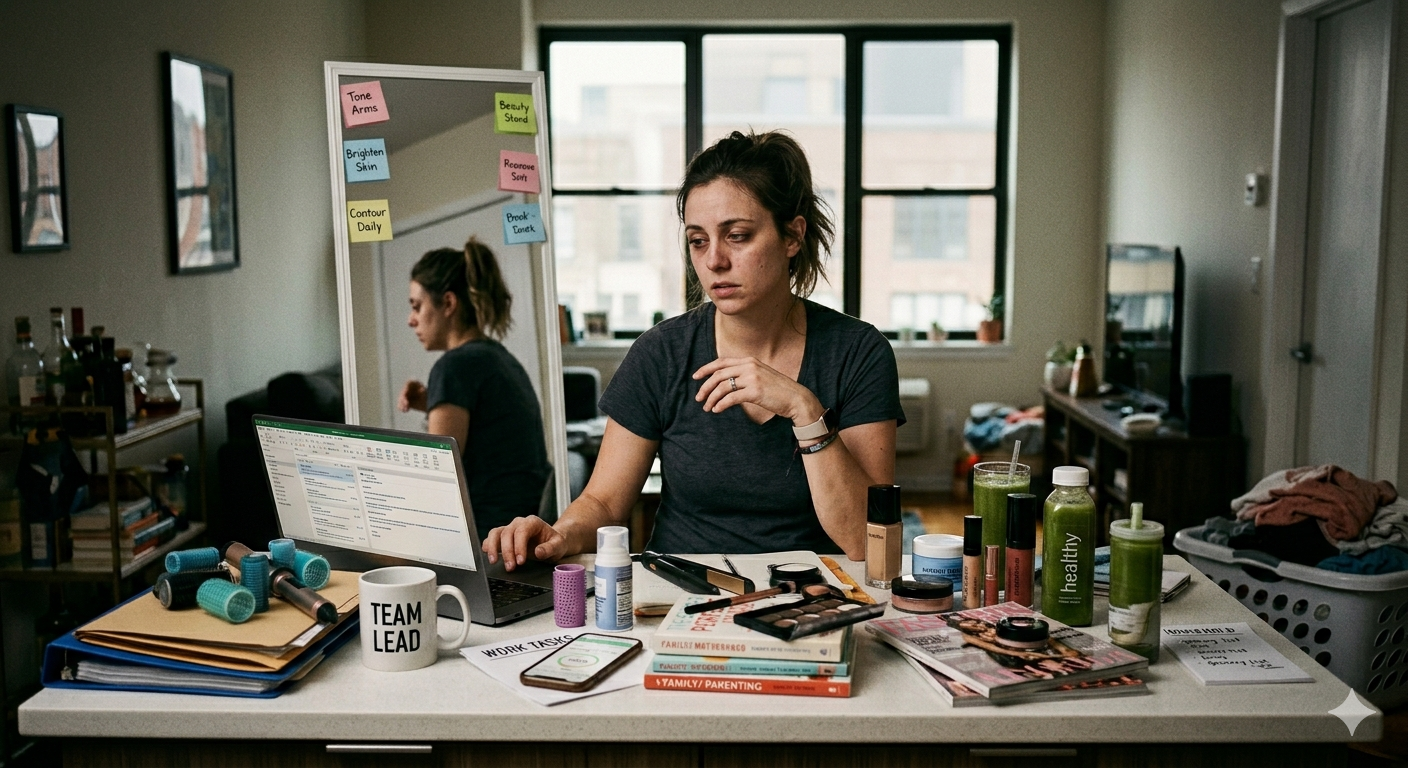
After years of exposure to these standards, many women end up internalizing that external pressure. They live their daily lives comparing themselves, competing, and feeling inferior solely because of their appearance.
Their self-esteem hangs by a thread, and their anxiety grows ever stronger. The fear of not being enough and of being constantly criticized becomes an emotional burden. Every detail that doesn't "fit" ends up becoming a source of insecurity. Thousands of women spend their days meticulously planning how they should look, how they should speak, and even what they should feel.
Constant hypervigilance eventually exhausts both mind and body. This isn't just a matter of beauty or personal preference; it's a matter of mental health. Living by impossible standards can lead to anxiety, obsessive-compulsive disorder, depression, and a profound sense of inadequacy. Is it worth living this way just to fit in?
Life should feel like a breath of fresh air. Our minds should be our greatest ally, not our enemy; our bodies should be cherished, not constantly criticized. Women deserve to be valued for who they are, not just for how they look.
We've spent so much time trying to fit in that we've forgotten what it feels like to simply be. We've measured ourselves against impossible standards and learned to see ourselves through other people's eyes. Perhaps it's time to start looking at ourselves with our own eyes.
What if much of what you've chosen to be is just a way of trying to fit in?
How many parts of who you are were truly chosen by you and not by what you learned you were supposed to be?
References:
Atwood, M. (1985). The Handmaid's Tale. Salamandra.
Gaitán, F. (Creator). (1999–2001). Yo soy Betty, la fea [Television series]. RCN Televisión.
Gilman, C. P. (1915). Herland. Pantheon Books.