
- Member of -

EDITORIALS:

More studies, same gap: gender, income, and caregiving

Author:

Mireya Mondragon Cervantes

About

An economist from the National Autonomous University of Mexico (UNAM) with experience in public finance, budget analysis, and public spending monitoring. She began her professional career at the Belisario Domínguez Institute of the Mexican Senate, where she was part of the General Directorate of Finance, gaining experience in public finance. She worked as a researcher and coordinator in the area of public spending at the Center for Economic and Budgetary Research (CIDE), addressing issues related to social policy, social programs, federal public administration projects, the economics of care, and fiscal space. She also collaborated as a researcher on the spending program at México Evalúa. She seeks to influence public policy decision-making to achieve a positive impact on the well-being of the population.

Location:

Author Publications:

Share this post:

VOICES:

More studies, same gap: gender, income, and caregiving

Author:

Mireya Mondragon Cervantes

About

An economist from the National Autonomous University of Mexico (UNAM) with experience in public finance, budget analysis, and public spending monitoring. She began her professional career at the Belisario Domínguez Institute of the Mexican Senate, where she was part of the General Directorate of Finance, gaining experience in public finance. She worked as a researcher and coordinator in the area of public spending at the Center for Economic and Budgetary Research (CIDE), addressing issues related to social policy, social programs, federal public administration projects, the economics of care, and fiscal space. She also collaborated as a researcher on the spending program at México Evalúa. She seeks to influence public policy decision-making to achieve a positive impact on the well-being of the population.

Location:

Author Publications:

Share this post:

NEWS:

More studies, same gap: gender, income, and caregiving

Author:

Mireya Mondragon Cervantes

About

An economist from the National Autonomous University of Mexico (UNAM) with experience in public finance, budget analysis, and public spending monitoring. She began her professional career at the Belisario Domínguez Institute of the Mexican Senate, where she was part of the General Directorate of Finance, gaining experience in public finance. She worked as a researcher and coordinator in the area of public spending at the Center for Economic and Budgetary Research (CIDE), addressing issues related to social policy, social programs, federal public administration projects, the economics of care, and fiscal space. She also collaborated as a researcher on the spending program at México Evalúa. She seeks to influence public policy decision-making to achieve a positive impact on the well-being of the population.

Location:

Author Publications:

Share this post:

EXPERIENCES:

More studies, same gap: gender, income, and caregiving

Author:

Mireya Mondragon Cervantes

About

An economist from the National Autonomous University of Mexico (UNAM) with experience in public finance, budget analysis, and public spending monitoring. She began her professional career at the Belisario Domínguez Institute of the Mexican Senate, where she was part of the General Directorate of Finance, gaining experience in public finance. She worked as a researcher and coordinator in the area of public spending at the Center for Economic and Budgetary Research (CIDE), addressing issues related to social policy, social programs, federal public administration projects, the economics of care, and fiscal space. She also collaborated as a researcher on the spending program at México Evalúa. She seeks to influence public policy decision-making to achieve a positive impact on the well-being of the population.

Location:

Author Publications:

Share this post:

Youth in the World:

More studies, same gap: gender, income, and caregiving

Author:

Mireya Mondragon Cervantes

About

An economist from the National Autonomous University of Mexico (UNAM) with experience in public finance, budget analysis, and public spending monitoring. She began her professional career at the Belisario Domínguez Institute of the Mexican Senate, where she was part of the General Directorate of Finance, gaining experience in public finance. She worked as a researcher and coordinator in the area of public spending at the Center for Economic and Budgetary Research (CIDE), addressing issues related to social policy, social programs, federal public administration projects, the economics of care, and fiscal space. She also collaborated as a researcher on the spending program at México Evalúa. She seeks to influence public policy decision-making to achieve a positive impact on the well-being of the population.

Location:

Author Publications:

Share this post:

Author:

Mireya Mondragon Cervantes

About

An economist from the National Autonomous University of Mexico (UNAM) with experience in public finance, budget analysis, and public spending monitoring. She began her professional career at the Belisario Domínguez Institute of the Mexican Senate, where she was part of the General Directorate of Finance, gaining experience in public finance. She worked as a researcher and coordinator in the area of public spending at the Center for Economic and Budgetary Research (CIDE), addressing issues related to social policy, social programs, federal public administration projects, the economics of care, and fiscal space. She also collaborated as a researcher on the spending program at México Evalúa. She seeks to influence public policy decision-making to achieve a positive impact on the well-being of the population.

Location:

Author Publications:

Author networks:

Website:

Share this post:

Twitter
Facebook
WhatsApp
Telegram

Subscribe to the newsletter
of Youth:

By Mireya Mondragón Cervantes
Researcher at Ethos Innovation in Public Policy

An idea that is constantly repeated when we talk about social mobility The idea is that “if you study more, you’ll do better.” Generally speaking, this is true. In Mexico, household income tends to increase as the head of household’s education level rises. However, this improvement is not equally distributed between men and women, as female-headed households face an economic disadvantage that even higher academic degrees cannot overcome.

Before discussing studies, there is a clear reality: Gender sets the income ceilingAccording to the National Survey of Household Income and Expenditure (ENIGH) 2024A female-headed household earns, on average, 14,123 pesos per month in labor income, while in male-headed households the figure rises to 18,502 pesos. In other words, the labor income of female-headed households is 24% lower than that of male-headed households.

We might think that education reduces this income gap, but the data shows the opposite. Higher levels of education lead to higher household income; in other words, this ladder toward social mobility exists. However,The gap between male-headed and female-headed households persists at all educational levels And, far from disappearing, it tends to expand precisely where it would be expected to close.

It is at the highest levels of specialization where the labor market most severely penalizes households headed by womenThe average monthly income of a household headed by a professional male is 29,319 pesos, while a household headed by a female with the same level of education earns 22,037 pesos, 25% less. This data reveals that even with professional education, households headed by women continue to fall behind.

Inequality between women and men doesn't only occur once they are in the labor market, but from the moment they enter it. If we look at labor force participation rates, we understand part of the problem, because in 2025, while 74.8% of men were in the labor market, the percentage for women was only 45.7%. This difference of almost 30 percentage points tells us that Many women are outside the labor market, but not by choice; the main reason is that they are occupied with tasks that the market does not pay for: care work..

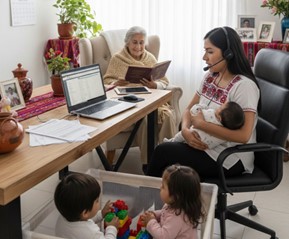
When the responsibility for caring for children, people with disabilities, or older adults falls disproportionately on women, their access to better-paying employment opportunities is limited. One of the causes of this inequality lies in the insufficient care infrastructure. When the state does not provide sufficient quality care services, it is women who bear the cost of this deficiency through their time and unpaid work.

So, while higher levels of education are key to social mobility, this approach doesn't have the same effects on women and men. In fact, to access its benefits, women must first overcome other barriers, such as limited access to the labor market, primarily related to their caregiving responsibilities. In this sense, a public policy that addresses the root of the problem is needed. The creation of Annex 31 for the Consolidation of a Care Society by 2026, with a budget of 466.675 billion pesos, is a step forward, as it recognizes that caregiving is not a private matter, but rather a component of the economic structure.

However, the annex alone is not the solution. Transforming that budget into a systemic policy that truly reduces gaps requires coordination, sufficient and high-quality services, and a clear path that translates into more women being able to enter, remain, and advance in the labor market, while receiving equal pay.

Closing the gaps means ensuring that education translates into real opportunities regardless of the gender of the head of household.If the goal is economic growth and the well-being of the population, a care system must cease to be a budgetary promise and become services that free up time and open the door to the labor market for more women.

It is a free and accessible digital platform that serves as an information and collaboration tool between youth and institutions for employability in CDMX

More posts from Mireya Mondragon Cervantes:

More posts from Mireya Mondragon Cervantes: