


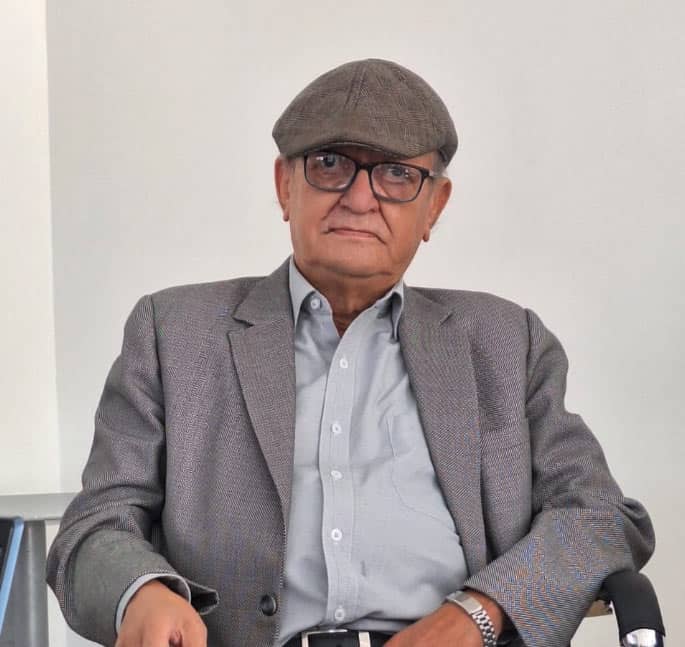
By Elio Villaseñor G.
Director General of Citizen Initiative
for the Promotion of a Culture of Dialogue, AC
“Life is a journey and the important thing is not the destination,
but the people we meet along the way.”
Inspired by the message of various Calle 13 songs.
The place where we live is much more than an address on a map. It's the space where we live with our family and friends; where we went to school, played in the streets, explored parks, used public transportation, and began to discover the world around us.
It is also the place where our dreams, our questions, and our desire to build a better future are born.
Growing up in our neighborhoods and communities, we observe situations that worry us: the lack of opportunities, insecurity, abandoned spaces, or the difficulties in continuing to study and finding a decent job.
Sometimes it seems that these problems are part of the everyday landscape and that nothing can change. However, there comes a moment when reality shakes us and makes us ask ourselves:
What can I do to improve my environment?
That's when the desire to participate, to organize ourselves, and to look for alternatives arises.
As one young participant expressed:
“If I had been told that I could collaborate in building a space that considers the participation, influence and activism of young people as the main axis for their preparation as agents of change, I would have felt nervous, anxious and expectant about what was to come.”
That first step is often accompanied by doubts and uncertainty. But it also opens the possibility of discovering that problems are not inevitable and that we too can be part of the solutions.
Our concern grows when we find other young people who share the same worries and the same desire to transform their community. We understand that we are not alone and that the most important changes begin when we decide to act together.
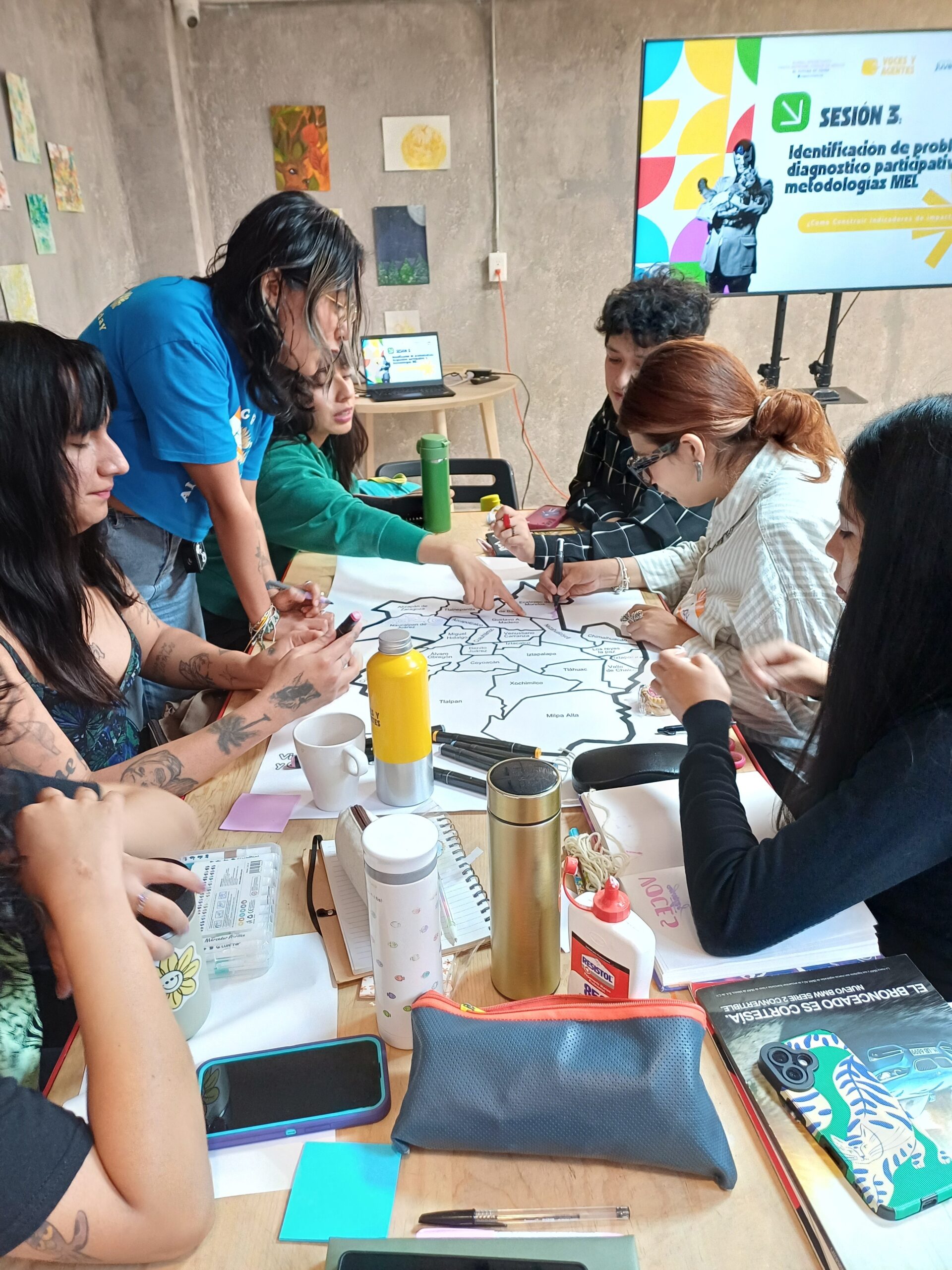
Along that path we found Voices and Agents: Laboratory of Youth Advocacy and Action, a space for learning, reflection and action where young people from different territories of Mexico City and its metropolitan area participate, coming from Iztapalapa, Gustavo A. Madero, Cuauhtémoc, Tlalpan, Magdalena Contreras, Coyoacán, Álvaro Obregón, Cuajimalpa and Ecatepec.
From their neighborhoods, communities, and communities, young people share experiences, concerns, and proposals to imagine new forms of participation, influence, and social transformation.
Through this process we learn to read our reality with new eyes, to identify problems, to dialogue with different actors, to build proposals and to develop tools to promote concrete changes in our territories.
But it also leads us to ask fundamental questions:
"Are young people being observed, but also listened to, and are their actions regarding advocacy, activism, or participation being taken?"
The answer isn't always simple. However, more and more young people are demonstrating that they have ideas, proposals, and an enormous capacity to build solutions when given trust, space, and opportunities.
We are gradually understanding that transforming our community doesn't depend solely on other people. It also depends on our ability to participate, organize ourselves, and join forces to build the common good.
Every community activity, every proposal promoted, every space recovered, and every alliance built are steps that strengthen our quality of life and that of those around us.
As another participant expressed it:
“…to build a safe, caring and inclusive space, with a narrative that considers the voice, identity and social struggle of youth in advocacy…”
The great challenge of our generation is not to let problems overwhelm us or indifference paralyze us.
It's about believing in our ability to change things, taking responsibility, and working together to build opportunities where they previously seemed not to exist.
Because when young people participate, engage in dialogue, and take action, they cease to be spectators of reality and become protagonists in the transformation of their communities.
Collective work is an essential part of that process. No profound transformation is achieved alone. Lasting changes are born from collaboration, trust, and shared creation.
That is why the reflection of another young participant is so valuable:
“Collective work is a fundamental part of this project which, through content generated for networks, takes up with total determination that everything that is built for young people must count on us for its elaboration, participation and presence.”
And perhaps that is the most important lesson: our neighborhood, our community, and our community are not only the place where we live; they are also the place from where we can begin to build a future with more dignity, opportunities, and hope for everyone.
Ultimately, transforming our community isn't just about reaching a goal. It also means learning to walk alongside others, building friendships, joining forces, and discovering that the most profound changes happen when we share the journey with those who believe a better future is possible.
True transformation begins when we stop asking who will solve the problems in our environment and decide to be part of the answer.
That's where young people make their mark: when they turn their dreams into actions, their ideas into proposals, and their commitment into a force capable of transforming reality.
Because the future is not a place we arrive at; it is a path we build together, step by step, from our communities.
As one of the young voices inspiring this effort summarizes:
“Being a young person of opportunity means having hope to be able to change the future of our environments.”