


By the Mexican Institute for Competitiveness (IMCO)
-
More than half of the women have informal employment.
-
For every 100 pesos a man earns, a woman earns on average 86 pesos.
-
73% of the country's unpaid work is done by women, which limits their economic participation.
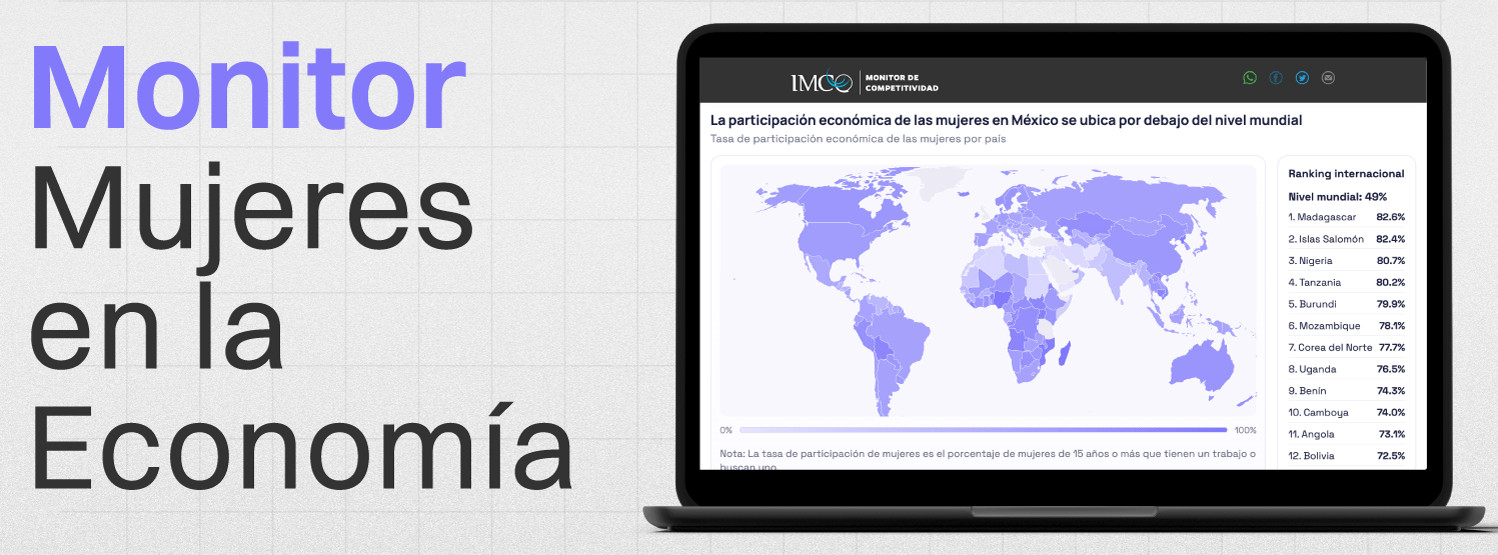
The Mexican Institute for Competitiveness (IMCO) presented the monitor Women in the Economy, a unique platform that brings together more than 40 key indicators on women's economic participation and their working conditions at the national, state and Mexico City borough levels.
The monitor is a public and interactive tool that will be updated periodically with the aim of facilitating access to data with a gender perspective, monitoring labor gaps and generating evidence that contributes to the design of public policies that promote the economic participation of women.
National
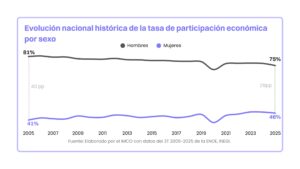
Between 2005 and 2025, the economic participation rate of women in Mexico increased slightly, rising from 411 to 461 in the last two decades. This figure remains far below the participation rate of men (751).
Although the gap between men and women reaches 29 percentage points (pp), it narrowed by 11 pp during this period. This decrease is explained by both the gradual increase in women's participation (average annual growth rate of 0.5%) and a reduction in men's participation (-0.4%).
-
High levels of informality persist, especially among women (55%). The difference compared to men (49%) remains similar to that recorded in 2005.
-
While informality offers greater labor flexibility, it also implies lower levels of social security, stability and income, which deepens inequality between women and men.
-
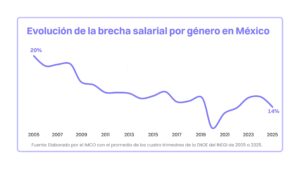
The wage gap persists in 14%, meaning that for every 100 pesos a man earns, a woman receives on average 86 pesos.
-
This inequality reflects structural factors such as the concentration of labor in certain sectors, a greater presence in informality, and interruptions associated with caregiving.
-
Women perform 731,000 tons of domestic and care work. Overall, the economic value of unpaid work is equivalent to 241,000 tons of national GDP—the same proportion as in 2020—and exceeds the value of strategic sectors such as manufacturing (201,000 tons) and commerce (191,000 tons).
State
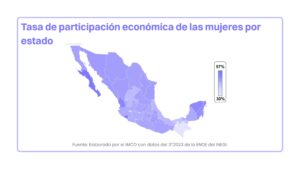
No federal entity offers optimal working conditions for women to participate and develop in the labor market, according to States # with Gender Lens 2025 from IMCO.
Six states have a female economic participation rate above 501%: Baja California Sur, Colima, Mexico City, Nayarit, Yucatán, and Quintana Roo. At the other end of the spectrum, with the lowest participation rates, are Veracruz and Zacatecas with 411%, followed by Tabasco (38.51%) and Chiapas (301%).
-
Educational attainment drives economic participation. More than half of women in Mexico City, Baja California Sur, and Sinaloa have at least a high school diploma, while in Guerrero, Oaxaca, and Chiapas the proportion is close to 30%.
-
Insecurity reduces women's economic opportunities. In Colima and the State of Mexico, more than a third of women have stopped using public transportation for fear of crime, limiting their mobility and access to the labor market.
Mexico City
Women's economic participation in Mexico City is the highest in the country; however, the quality of employment remains a challenge, particularly for... young womenwho face higher levels of informality and job insecurity.
-
The capital city has the highest proportion of educated women, with seven out of ten women aged 18 and over having at least a high school diploma.
-
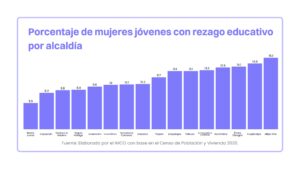
The boroughs with the lowest rates of educational lag among young women tend to have higher economic participation. For example, in Coyoacán, 81% of young women did not complete compulsory education at the expected age, while 571% participate in the labor market, placing the borough second in both categories.
Promoting women's participation in the labor market is a driving force for strengthen Mexico's growthReducing gaps in access to employment, improving the quality of job opportunities, and redistributing care work will allow talent to be fully utilized.
Having timely and accessible gender-sensitive data is a first step towards designing public policies that promote greater economic inclusion and a more equitable labor market.
The monitor is more than a data repository; it is a tool designed to facilitate analysis and contribute to more inclusive decision-making.
To consult key indicators on women in the Mexican economy, visit our monitor at https://imco.org.mx/monitor/mujeres-en-la-economia/You will be able to download the data, as well as consult ballots for the 32 federal entities and the 16 boroughs of Mexico City.