


By the Mexican Institute for Competitiveness (IMCO)
Center for Public Policy Research
On September 23, 2025, the Mexican Institute for Competitiveness (IMCO) presented the Women in Mexico City Monitor, a digital tool with variables on employment, education, care and access to social security, which includes ballots by borough with key indicators that highlight the main advances and challenges at the local level, as well as public policy recommendations to promote greater equality of opportunity in the City.
Including more young women in education and the labor market is a way to boost the economic and social development of Mexico City.
-
Women's economic participation in the city is the highest in the country, but job quality remains a challenge. The proportion of young women in informal employment in Xochimilco is 711.
-
Seven out of 10 young women who do not participate in the labor market dedicate themselves exclusively to the home and caregiving.
-
In Mexico City, 271% of young women lack access to health services.
Over the past three decades, one of the major advances for young women has been increased access to education. However, significant challenges remain, particularly for those who are neither studying nor participating in the labor market. In Mexico, one in four young women finds themselves in this situation, placing the country 77th out of 166, according to the World Bank. This reflects a loss of potential for national development and underscores the urgent need to promote policies that foster their economic inclusion.
Given this situation, the Mexican Institute for Competitiveness (IMCO), with support from the Hilton Foundation, analyzed the socioeconomic conditions of young women in Mexico City (CDMX). The objective is to gain a deeper understanding of their participation in the city and generate evidence to inform the design of public and business policies at the local level. This research is particularly relevant in light of the demographic dividend, as it offers the opportunity to bring more young women into formal employment and strengthen the productive population of an aging city.
In Mexico City, 1.05 million women between the ages of 15 and 29 live, representing 221% of the total female population of the city. Of these, 371% are studying, 351% are participating in the labor market, and 151% are doing both. The remaining 121% are neither studying nor participating in the paid economy. The Mexican Institute for Competitiveness (IMCO) developed 20 indicators for each borough to better understand their realities.
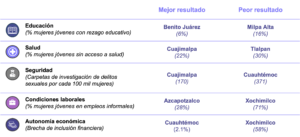
Education improves economic opportunities
The capital city has the highest proportion of educated women, with seven out of ten women aged 18 and over having at least a high school diploma.
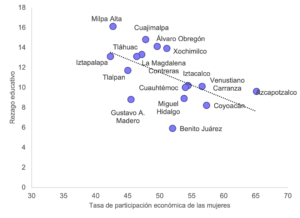
The boroughs with the lowest rates of educational lag among young women tend to have higher economic participation. In Coyoacán, 81% of young women did not complete compulsory education at the expected age, while 571% participate in the labor market, placing the borough second in both categories.
Job quality remains an ongoing challenge
Working conditions influence whether women remain in the paid economy. A key indicator of this is informality, which reflects whether work offers higher income, access to social security, and legal certainty.
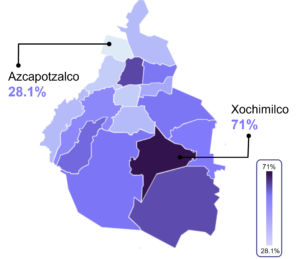
In Xochimilco, 71% of young women work in informal conditions, while in Cuajimalpa the proportion is reduced to 33%.
The quality of employment is related to the economic sectors in which women participate.
In Xochimilco, jobs in restaurants and commerce predominate, characterized by high levels of informality.
Meanwhile, in Cuajimalpa, professional services stand out, a sector with lower rates of informality.
Lack of access to health services prevails
Job quality is a decisive factor for access to health services, since in this country this right is closely linked to the type of employment.
In Mexico City, 271,000 young women lack access to public or private health services, a figure slightly higher than the national average (251,000). This figure varies among the boroughs, reaching 221,000 in Cuajimalpa, 241,000 in Tláhuac, and 301,000 in Iztapalapa and Tlalpan.
Insecurity limits economic participation
Public transportation allows for greater access to better job opportunities; however, in the southern region of the city (La Magdalena Contreras, Coyoacán, Benito Juárez and Tlalpan), 271% of women stopped using it for fear of becoming victims of crime.
This proportion is slightly reduced to 24% in the Eastern region, which includes Iztapalapa, Milpa Alta, Tláhuac and Xochimilco.
The cost of care also impacts young women
In Mexico City, six out of ten young people outside the education and labor system are women. This equates to 121 out of the total, although the proportion rises to 221 out of ten in Milpa Alta, the borough with the highest prevalence of this situation.
Seven out of ten women in the capital between the ages of 15 and 29 who do not participate in the labor market dedicate themselves exclusively to the home and caregiving.
On average, young women who are neither studying nor participating in the labor market dedicate 58 hours per week to unpaid work, while men dedicate 36 hours. In contrast, among young people who are studying and have paid employment, the time spent on these activities is reduced by half for both women and men.
Reflecting the persistent gender gaps in Mexico City, 351% of young women lack their own income, not including those who are solely dedicated to their studies. This situation presents an opportunity to promote more sustainable and inclusive economic growth, creating the conditions for more young people to achieve economic independence.

To bring women's economic participation in Mexico City in line with the OECD average (671% of total female workers), Mexico City (551% of total female workers) would need to add 850,000 women to the labor market. If this integration were to accelerate, the city's GDP could grow by 60 billion pesos over the next decade, representing an increase of 1.41% of total female workers. Young women are key to achieving this goal; therefore, IMCO proposes the following:
Formal employment. It is recommended that municipalities implement progressive programs, such as job-related training and access to first jobs, and that companies collaborate with youth networks to facilitate access to quality employment.
Care system. It is recommended that the Head of Government, in coordination with the boroughs, develop policies and programs to address local care needs. Furthermore, the Mexico City Congress has yet to approve legislation guaranteeing the right to care.
Consult the monitor at: https://imco.org.mx/monitor/mujeres-en-la-economia/